
Game nights in the Haldon household are often quite the spectacle—and, more importantly, a reliable source of truly memorable moments. Sometimes, it’s a gathering of our nearest and dearest grown-up friends, fuelled by a hearty (and occasionally somewhat charred) BBQ banquet before descending into a very serious, very competitive, and increasingly drunken game of Cards Against Humanity.
Other times—and perhaps more often—it’s family game night, where my good lady wife, our three children and I settle in for a tense and highly strategic battle of Monopoly, Guess Who or Cluedo. These evenings can be fiercely competitive, occasionally dramatic, and never entirely above board—particularly when our youngest is involved, thanks to her frankly astonishing ability to cheat directly under our noses without so much as a flicker of guilt. In short, game night in the Haldon household is rarely quiet, rarely straightforward, and almost always a lot of fun.
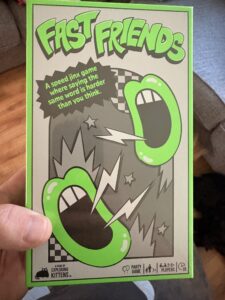
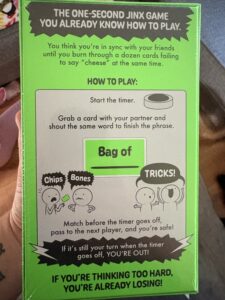
What we can all agree on, though, is that in this age of iPads, games consoles and seemingly endless digital distractions, nothing quite matches the simple, chaotic fun of a great card-based party game. There’s something crazy enjoyable about a good party game. Everyone can get involved, everyone understands the premise, and—best of all—there’s no barrier to entry. No complicated controls, no twelve-page rulebook. In recent years, when it comes to ridiculously good fun in a box, the team behind Exploding Kittens have developed an uncanny abillity for taking the simplest of playground games and turning them into gloriously chaotic party experiences.
Fast Friends is one of their newer offerings, and it’s a perfect example of that formula.
At its heart, it’s a fast-paced guessing game built around one deceptively simple question: how well do you really know the person sitting to the left of you? The premise is simple. You’re given a prompt, the clock starts ticking, and you and your Partner, Sibling, Friend or Family member have to try to come up with the exact same answer at exactly the same time. Easy, right? After all it’s just JINX!
Well… let me tell you, it really, really isn’t.
Because the moment the pressure is on, you quickly discover just how differently the people closest to you actually think. What you’re absolutely convinced they’ll say can turn out to be spectacularly wrong—and watching two people desperately try to get inside each other’s heads is where Fast Friends really comes alive. In a nutshell, this is Fast Friends…
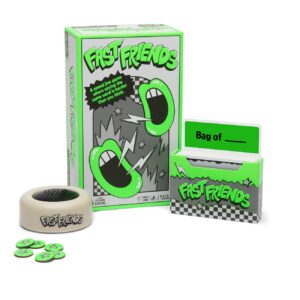
Fast Friends is best played with 2–8 players, aged 7 and upwards, with each game taking around 10 minutes. Of course, that can easily be extended with a few more rounds, particularly as there are four different sets of challenges to work your way through. When we played, we had the full Haldon household assembled: myself, the Missus and our three girls. Five players, five very different brains, and absolutely no shortage of opportunities to prove just how little we apparently know about each other!
So, what’s the aim? It’s beautifully simple: say the same word as another player at exactly the same time.
Think back to those moments at school when you and your mates would accidentally say the same thing simultaneously, look at each other and immediately shout “JINX!” before the other person could get their word in. Fast Friends takes that wonderfully simple playground moment and turns it into an actual game—and, as we discovered, a surprisingly competitive one at that. Because while saying the same word sounds easy enough, try doing it when you’re actively trying to predict what someone else is thinking. That’s when things get interesting…
The thing I loved most about Fast Friends is that you’re not really playing the game, you’re playing the person sitting next to you. When we played, our ages ranged from 10 to 40, and believe me, we were all operating on very different wavelengths. That’s something you quickly learn to take into account. When I was paired up with my 18-year-old daughter, for example, my brain immediately went into movie and TV-reference mode. Pair me up with the Missus, however, and suddenly I’m thinking more along the lines of song lyrics and musical references.
And that’s what makes the game so much fun. Every pairing feels different. You have to work out how the other person thinks, what they’re likely to say and, ultimately, whether your brains are capable of syncing up for long enough to produce the same answer.
It also makes for absolute chaos.
The basic gameplay is wonderfully simple. Two players draw a card, read the prompt, count down from three and then shout out their answers. Match? Brilliant. Pass the timer. Don’t match? Try again. And again. And again. And, yes… again. You keep going until you finally synch up—or the timer runs out. If it does, both players lose a Life Token, with everyone starting the game with three. Simple enough, right?
Almost too simple.
And because this is Exploding Kittens, the creators clearly decided that players were having far too relaxing a time and needed another layer of panic thrown into the mix. Enter the timer. Rather than giving you a nice, predictable amount of time to work things out, the timer randomly stops somewhere between 20 and 75 seconds. Which means you never quite know how long you’ve got. Twenty seconds? Panic. Seventy-five seconds? Plenty of time.
Or so you think… That random timer adds a brilliant little layer of tension because every failed attempt brings you closer to the inevitable beep. You can feel the desperation building as you and your partner desperately try to get inside each other’s heads before your time—and your precious Life Tokens—run out.How’s that for tension?
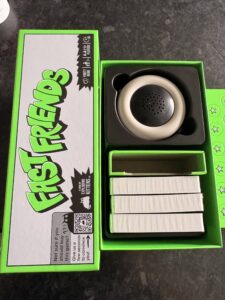
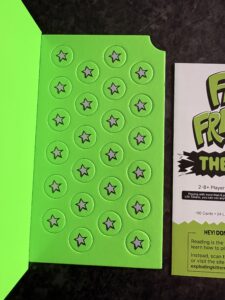
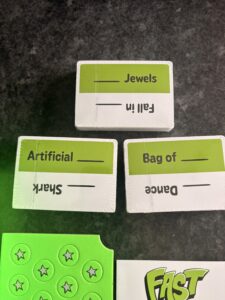
If all of that still sounds a little chaotic and you’re wondering how the hell you’re supposed to keep track of it all, don’t worry—Fast Friends is actually incredibly easy to get your head around. There’s a very handy how-to-play video over on the Exploding Kittens website, which I made the entire family watch before we started. There’s also a QR code included on the rules map—sorry, leaflet. For some reason, I always call instruction leaflets maps. I have no idea why. Or, if you’re feeling particularly old school, you can do what people did before QR codes existed and simply read the rules.
Setting Up
Setup is nice and straightforward, although you will need to put 2 x AAA batteries into the buzzer, so grab a small screwdriver before you start. We played with five people, but Fast Friends works with anywhere from 2 players upwards, and there’s a handy switch underneath the buzzer that lets you select either 2 players or 3+ players. Everyone starts with 3 Life Tokens, then give the cards a good shuffle and place a pile into the rather handy card holder provided.
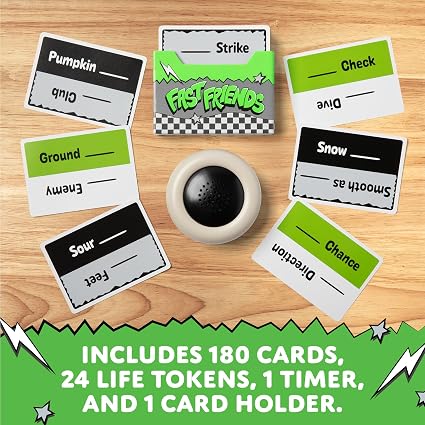
And here’s a nice little touch: the cards are double-sided, meaning there’s plenty of gameplay available if you’re having such a good time that one round simply isn’t going to cut it. And trust me, once you get into it, there’s a very good chance you’ll want to keep going. The challenge cards come in four different colours—green, white, black and grey—giving you plenty of variety as you work your way through the game.
So, batteries in, cards shuffled, Life Tokens distributed and family friendships already hanging by a thread…
Time to Play
Pick your starting positions, and the player sitting to your left becomes your first partner. Push the buzzer, grab a card, show it to your partner and get ready. Each card gives you a one- or two-word phrase followed by a blank. Your job is to fill in that blank by shouting out your answer at exactly the same time as your partner.
And here’s the important bit: there is no right answer.
You’re not trying to guess what the game wants you to say. You’re trying to guess what your partner is going to say.
Get the same answer out at the same time before the buzzer sounds? YES! You’ve got it. Discard the card, pass the card holder to your partner, and they now team up with the player to their left for the next challenge. Don’t match? No problem. Grab a new card and go again. And again. And again. Until you finally synch up… or the timer runs out. If the buzzer catches you out, both players lose a Life Token. Then it’s on to the next pairing. The game continues like this, with everyone getting the chance to partner up with different players and discover just how similarly—or spectacularly differently—you think.
And the winning part?It’s not about being the quickest, cleverest or having the best answers. It’s simply about keeping hold of those precious Life Tokens. When the game ends, the player with the most Life Tokens wins. Simple, right?
Well… it is until you realise you’re now trying to predict exactly what your 10-year-old is going to say when presented with the phrase “Peanut ____”.
Our Verdict
As a family, we thoroughly enjoyed Fast Friends. It’s simple, fast-paced and ridiculously easy to pick up, but don’t underestimate just how much of a difference that can make to a family game night. Sometimes the simplest games are the ones that get everyone involved the quickest. There’s no twenty-minute explanation, no complicated setup and no need to spend the first half of the evening arguing over the rules. Within minutes, everyone is playing, laughing and, in our case, slowly descending into complete mental chaos.
As I mentioned earlier, the real magic comes when you stop thinking about what you should say and start thinking about what you think your partner will say. That’s where Fast Friends really comes alive. And it’s also where the family aspect takes things to another level. You start to think you know someone pretty well, only to discover that when the pressure is on, the two of you might as well be operating on completely different planets. Don’t get me wrong, though—you will brain-fart. You will overthink things. You will panic. You will blurt out something completely and utterly preposterous.
And, on occasion, you may even say something you probably shouldn’t when your partner happens to be your 10-year-old daughter. Or, in our case, your 10-year-old daughter may say something equally questionable to you. Trust me. It happened. And honestly, that’s another area where Fast Friends excels. The rotating nature of the game keeps everything fresh and fast-moving. You’re constantly playing with different people, and every pairing brings a completely different dynamic. No two rounds felt the same.
In fact, as we went on, the confidence slowly disappeared and the desperation steadily increased. We started off thinking we had this game absolutely nailed. By the end, we were staring at each other like complete strangers, desperately trying to work out what on earth the other person was thinking. And yes, you could absolutely introduce your own family rules, add little house challenges or tweak things as you go. There’s plenty of room to put your own spin on it. But honestly? You really don’t need to. Fast Friends has been designed so simply and effectively that it works brilliantly straight out of the box.
Even the Missus loved it—and, as it turns out, she is annoyingly good at it. Apparently, she knows the rest of us like the back of her hand, while the rest of us clearly need to invest in some form of family therapy.
But hey… Isn’t that what game night is all about? Right?
Haldon Family Rating: ⭐⭐⭐⭐
I don’t usually rate games like this.
But if I’m going to put my money where my mouth is, then Fast Friends gets a very well-deserved 4/5 from the Haldon family.
It’s incredibly easy to pick up, takes minutes to understand and yet somehow delivers more laughs, chaos and entertainment than many of the more complicated games we’ve played. I’d definitely recommend playing with a bigger group if you can. The more people around the table, the more unpredictable the pairings become, and that spontaneous chaos is where Fast Friends really shines. The replayability is also pretty damn obvious. We’ve already sat down as a family to play Fast Friends three separate times, and we’ve loved it every single time.
For a game that is essentially built around trying to say the same word as someone else, it has an impressive ability to keep giving you completely different experiences.
Easy to learn. Fast to play. Hilariously chaotic.
Four out of five from us.

Kevin has been reviewing and just generally talking about movies into a Microphone or written onto a page for about 15 years now. It was time for hime to finally put himself back in the thick of it and bring the world Off The Reel. you can expect Reviews, Interviews, Festival Coverage, Yoututbe Content and much much more as he chips away at the industry and brings the talk off the reel.